Hit enter to search or ESC to close
3 April 2026
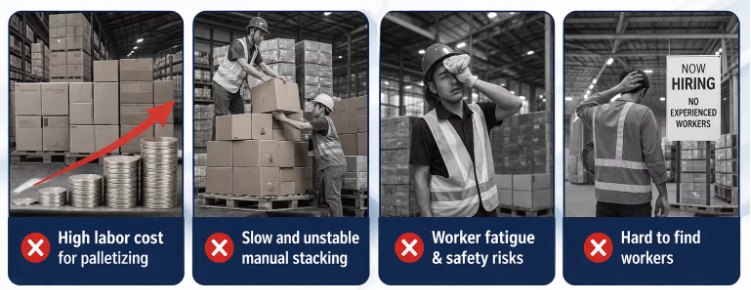
In most factories, labor cost does not increase evenly across the production process. It tends to accumulate in positions that are repetitive, physically demanding, and difficult to sustain over time.
Palletizing is one of those positions.
At the end of the line, operators are responsible for continuously handling finished products—lifting, aligning, and stacking cartons under time pressure and across multiple shifts. Over time, this type of work leads to instability rather than simple staffing.
It is common to see frequent rotation of workers, reliance on temporary labor, and increasing use of overtime to maintain output.
Read more:https://www.autopackjet.com/news/what-is-a-cobot-palletizer-and-how-does-it-work.html
 |  |
When evaluating labor cost, many factories focus on wages. In palletizing, that only reflects part of the picture.
The actual cost is tied to how stable the operation is.
Manual palletizing introduces variability:
·operators work at different speeds
·fatigue affects consistency within a shift
·staffing gaps interrupt the workflow
·training cycles delay stable performance
These factors translate into indirect costs, including repeated recruitment, extended training time, and reduced production consistency.
Over time, these hidden costs often exceed the visible wage component.
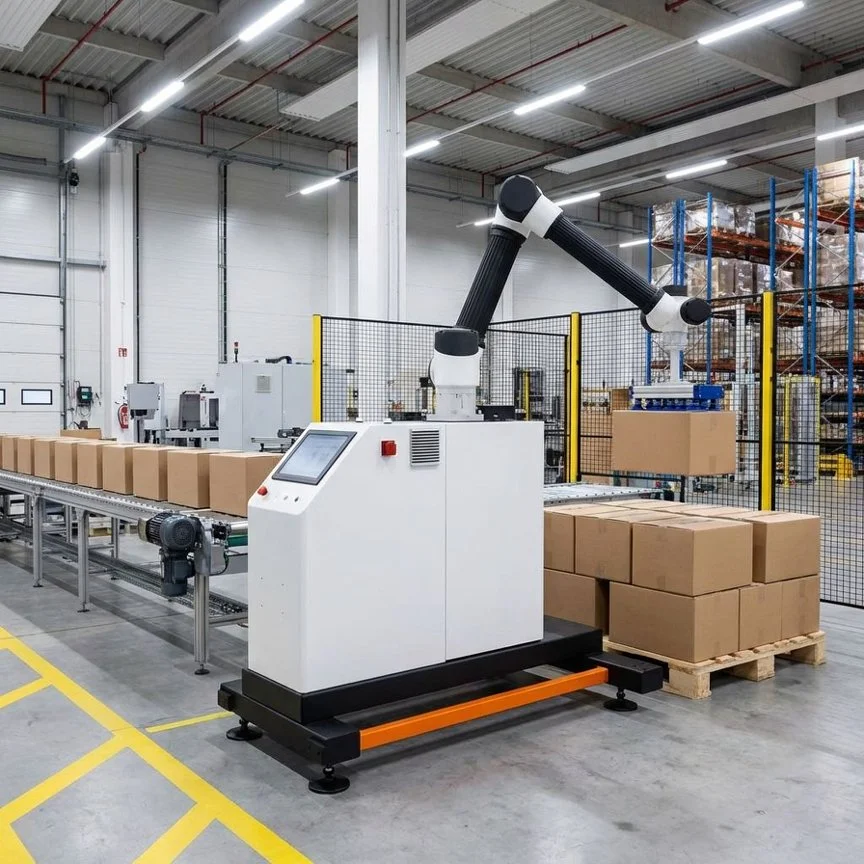
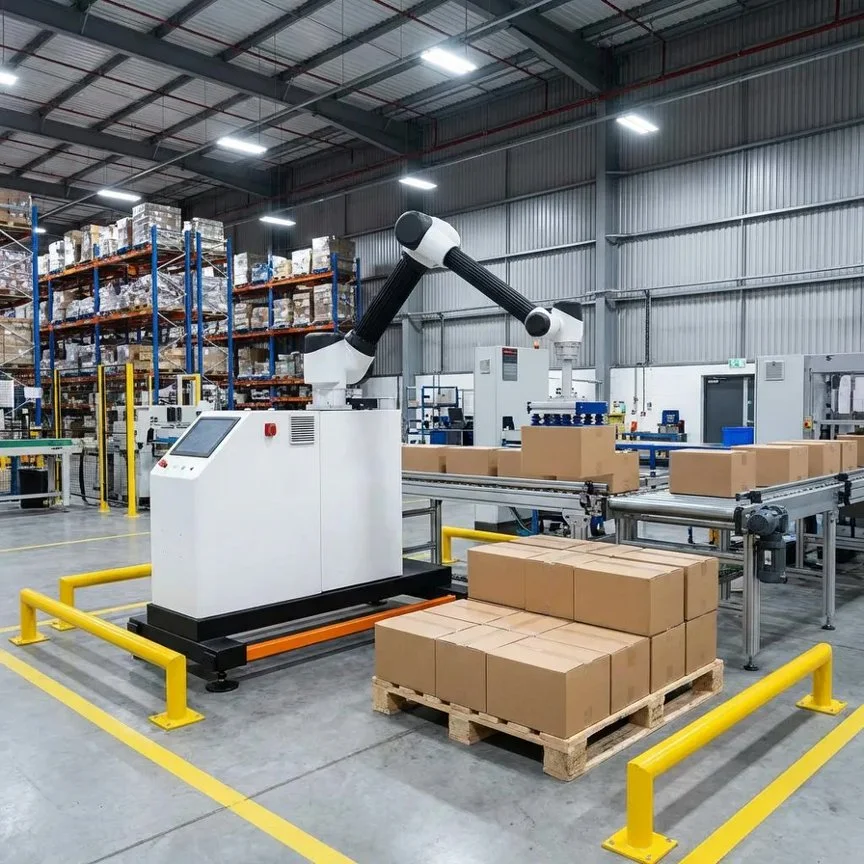
A cobot palletizer changes how palletizing is performed.
Instead of relying on operators to carry out repetitive lifting and stacking, the system handles these tasks continuously and with consistent timing.
This leads to several practical changes:
·fewer workers are required to stay at the palletizing position
·operators can be reassigned to monitoring or material handling
·production becomes less sensitive to staffing fluctuations
The role of labor shifts from physical execution to process support.
| Cost Area | Manual Palletizing | With Cobot Palletizer | Effect |
|---|---|---|---|
| Staffing | Fixed operators per shift | Reduced dependency on dedicated roles | Lower baseline labor requirement |
| Overtime | Used to maintain output | More stable operation | Reduced overtime usage |
| Turnover | High in repetitive positions | Less reliance on manual tasks | Lower recruitment and training cost |
| Consistency | Operator-dependent | Process-driven | More predictable performance |
| Ergonomic load | Continuous lifting | Automated handling | Reduced disruption risk |
Labor cost reduction becomes measurable when variability is reduced and the process becomes more consistent.
In manual palletizing, labor performance directly affects production flow.
When handling speed drops, cartons begin to accumulate. Once buffer limits are reached, upstream processes are forced to slow down or stop.
This creates a chain effect where labor limitations reduce overall equipment efficiency.
By maintaining a consistent handling rhythm, a cobot palletizer helps stabilize the end-of-line process and reduces the likelihood of these disruptions.
The need for palletizing automation usually emerges when labor starts to limit performance rather than support it.
A cobot palletizer is commonly considered in situations where:
·palletizing requires continuous manual effort across shifts
·labor availability is inconsistent
·overtime becomes necessary to maintain output
·production involves multiple product formats
In these cases, labor cost is no longer a fixed expense—it becomes a variable risk.
Reducing labor cost in factories is not only about reducing the number of workers. It is about reducing dependence on repetitive and unstable tasks.
A cobot palletizer contributes to this by shifting palletizing from a labor-driven activity to a controlled and consistent process.
In environments where labor is difficult to maintain and production conditions vary, this shift provides a more stable way to manage cost at the end of the line.